
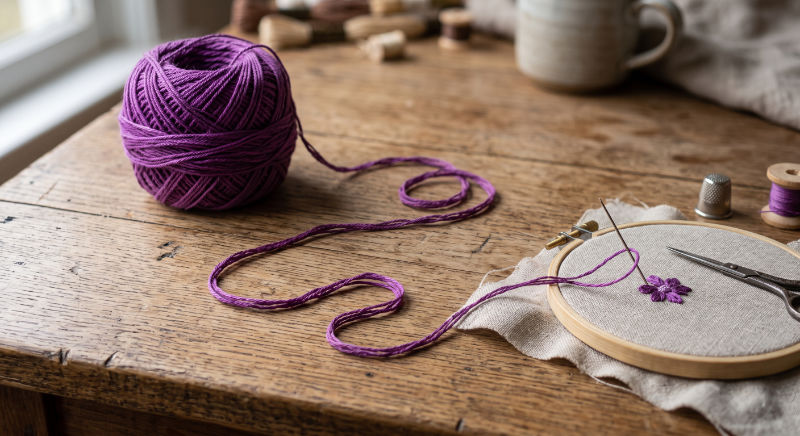
Stand in front of a thread display and the choices pile up fast: cotton or polyester, six strands or one, size 5 or size 12.
Most decisions come down to three questions. What is the item made of, how will it be washed, and how bold should the stitches look?
Use the following order to narrow your options, so you can spend more time stitching and less time second-guessing.
Start with fiber and finish
Fiber determines how the thread behaves. Its finish affects how it catches the light.
Cotton floss is a reliable choice for hand embroidery. DMC six-strand cotton floss comes in 8.7-yard skeins and is certified to OEKO-TEX Standard 100, which may matter when reviewing materials for baby gifts.
Polyester is practical for machine embroidery on items that receive frequent or heavy washing. Madeira lists its Polyneon polyester thread as resistant to abrasion, sunlight, and chlorine bleach. The company notes that Classic Rayon is not suitable for harsh commercial laundering, bleaching, or outdoor use, so rayon is better suited to decorative pieces.
Choose a sheen that complements the fabric, not just the color sample. Matte cotton looks soft on linen, while glossy thread stands out on smooth quilting cotton.
Stranded or perle: what changes?
Stranded cotton consists of six strands that can be separated. Use one strand for fine details or all six for bold lines and dense coverage.
Anchor Stranded Cotton, for example, is a six-strand, double-mercerized floss sold in 8 m skeins. It comes in solid and ombré shades, and the maker describes it as colorfast.
Perle cotton is a twisted, non-divisible thread with a soft satin finish. You stitch with it directly from the ball. DMC offers perle in sizes #3, #5, #8, and #12. The rule is simple: the lower the number, the thicker the thread. Anchor Pearl Cotton is available in #5, #8, and #12.
For outlines, lettering, and small details, consider #8 or #12. For chunky texture, large flowers, and kid-friendly stitches, try #3 or #5.
Weight numbers, decoded
Hand embroidery usually describes thickness by strand count or perle size. Machine embroidery commonly uses thread weight.
For machine work, 40 wt is a common starting point. Use a finer 60 wt thread for tiny lettering that might otherwise fill in. Choose 30 wt when you want bolder lines and more visible texture.
Polyester lines are designed for this workload. AMANN describes ISACORD 40 as a durable, abrasion-resistant polyester embroidery thread available in a broad color range.
Cotton weights also appear in hand stitching. One strand of Sulky 12 wt Cotton Petites provides coverage similar to two strands of standard embroidery floss, avoiding the need to separate and regroup strands.
Color planning that works
Choose values before individual colors. A mix of light, medium, and dark shades helps a design remain readable from across the room. Three shades of one hue often produce a clearer result than six unrelated bright colors.
Variegated threads deserve a test run. DMC notes that its Color Variations floss looks different depending on whether you complete one cross at a time or work in rows. Its Pearl Cotton Variations changes shade every few stitches, creating a tonal effect without repeated thread changes.
Posts on this site may contain brand partnerships, promotional content, or affiliate links. I may earn a commission or fee if you click a link or purchase through these recommendations at no additional cost to you.
For large filled areas, buy enough of one color at the start to keep the shading consistent. Simple DIY crafts and small samplers are useful for testing a palette before beginning a larger piece.
Match thread to how the item will be used
Towels, kids’ clothes, tote bags, and outdoor items are good candidates for polyester because it generally handles frequent washing and exposure better than delicate fibers.
Hoop art, samplers, and display pieces can use cotton or rayon because appearance may matter more than resistance to heavy laundering.
Follow the manufacturer’s care instructions rather than relying on fiber type alone. Color Variations floss is listed as colorfast to 60°C, or 140°F. The care guide for Pearl Cotton allows machine washing at higher temperatures but advises against bleach.
Store thread away from direct sunlight and dust. Keep loose skeins, balls, and spools in separate compartments so they do not tangle at the bottom of a bin.
Compare thread before buying
Once you know the fiber, weight, and palette, compare options by color family and thread type. Then decide whether the project calls for individual skeins or a coordinated set.
Browse thread for embroidery from Cottage Garden Threads by color and weight, with individual threads and curated packs available for different project sizes.
Cottage Garden Threads describes short color changes for its variegated threads, pre-cut 50 cm lengths for stranded thread, 15 m continuous lengths for perle, and packaging designed for controlled dispensing. Details like these are useful on any product page because they indicate how much cutting and re-threading a project may require.
Before choosing a thread, check the fiber, care instructions, thickness, length, and color-change pattern. These details make it easier to compare options that suit both the design and the finished item’s use.
Quick-pick cheat sheet
- Bold hand-stitched outlines: perle #5.
- Fine lettering by hand: perle #12 or one to two strands of floss.
- Tiny machine lettering: 60 wt polyester.
- Kids’ clothes and towels: washable polyester suited to frequent use.
- Soft tonal shading: variegated floss with a short color-change length.
- Fewer strand-separating steps: 12 wt cotton on a spool.
Frequently asked questions
Should I use floss or perle cotton? Choose separable floss when you want to adjust stitch thickness. Choose perle when you want a round, textured stitch without separating strands.
How do I test a new color palette? Stitch a small sample on the same fabric, then view it in daylight and room light before starting the full design.
