
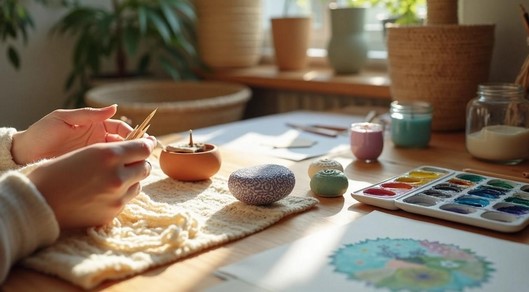
Have you ever noticed how stress seems to fade when you’re deeply focused on a calming craft? I certainly have. Engaging in relaxing crafts is a wonderful way to unwind, ease anxiety, and tap into your creative side.
For adults, these activities offer more than just a pleasant break from daily life. Working with your hands can lift your mood and give your mind something positive to focus on, helping push stressful thoughts aside. Crafting also supports cognitive function by engaging mental processes like problem-solving, planning, and decision-making.
In this article, we’ll explore why crafting has such a calming effect and how it benefits the brain. We’ll also look at some specific crafts that are especially effective for stress relief.
The Science of Crafting and the Brain
The magic of crafting does more than create beautiful objects—it changes our brain’s inner workings. Science shows why these calming activities provide such deep relief from daily stress.
How crafting activates the reward system
Posts on this site may contain sponsored content, paid link placements, or affiliate links. I may earn a commission or fee if you click a link or purchase through these recommendations at no additional cost to you.
Your brain enters a remarkable state of activation when you pick up knitting needles or start painting. Research shows that visual expression lights up the brain’s reward pathways. Blood flow increases by a lot to the prefrontal cortex—the brain’s command center that controls our thoughts, feelings, and actions.
This increased activity serves a purpose—it’s your brain’s reward circuit coming alive. Scientists found that this biological response explains why people feel pleasure while crafting, whatever their skill level or the final product. People who completed creative activities said they had “good ideas” and could “solve problems” better than before they started.
The role of dopamine in creative activities
Dopamine—our brain’s natural “feel-good” messenger—is a vital part of why relaxing crafts help adults relieve stress. Our brains evolved to release dopamine during activities needed for survival, and now they release it during enjoyable activities like crafting.
This chemical works as the body’s “natural anti-depressant” and creates positive feelings that make us want to continue the activity. A study of over 3,500 knitters revealed that 81% of people with depression felt happy after knitting, and more than half said they were “very happy”.
Crafting offers “slow-release dopamine”—a sustained form that builds long-term satisfaction and well-being—unlike the quick hits from social media or digital notifications. This explains the deep satisfaction of finishing a handmade project.
Crafting as a Form of Mindfulness
Crafting goes beyond creating beautiful things. The creative process can turn a simple activity into a powerful mindfulness practice.
How crafts help you stay present
Mindfulness teaches us to be fully present, aware of our thoughts, feelings, and surroundings without judgment. The crafting process moves your focus from just making something to experiencing each moment deeply. Mindful crafting encourages you to enjoy each step rather than rushing to finish a project.
Repetitive, rhythmic actions in crafting—like stitching, knitting, or crochet—create effects that feel like meditation. These movements naturally:
- Slow your breathing and steady your heart rate
- Decrease stress levels by regulating your nervous system
- Clear your mind as scattered thoughts become focused
Your hands and senses come alive during crafting, which makes it work well for mindfulness. The textures, colors, and sounds pull you into the present moment. You can improve relaxation by matching your breathing to your crafting—try breathing in as you start a new stitch and out as you complete it.
The link between flow state and reduced anxiety
Psychologist Mihaly Csikszentmihalyi created the term “flow” to describe that magical state where you become absorbed in an activity and time seems to stop. This state—often called being “in the zone”—happens naturally when your skill level matches the challenge of what you’re doing.
Creative activities can lower cortisol (the stress hormone) and boost serotonin levels, according to studies. Research shows that craft creation helps improve university students’ social well-being and mental health by promoting mindfulness and emotion regulation.
Flow Theory describes this focused, immersive psychological state that comes with a different sense of time and better intrinsic rewards. Students reach flow state during craft creation by setting clear goals, getting immediate feedback, and finding the right balance between challenges and skills.
Crafts That Engage the Senses
Our senses are at the heart of what makes crafts so relaxing. Creating with your hands gets multiple senses working at once. This gives you a complete experience that naturally takes your mind off stress.
Tactile crafts: knitting, crochet, and clay modeling
Touching and working with materials in tactile crafts brings real therapeutic benefits. The repetitive motions in knitting and crocheting help develop the hippocampus—a key brain region that controls spatial thinking. We don’t use these skills much in our GPS-driven world anymore.
Fiber arts give you rich sensory experiences you can’t get from screens and keyboards. A knitted or crocheted blanket feels nothing like your phone’s smooth surface. You get:
- Textural variations (bumps, lumps, and intentional holes)
- Finger exploration opportunities
- Warmth and comfort while still works-in-progress
Punch needle embroidery kits offer similar benefits, with the added satisfaction of creating vibrant textures through rhythmic, repetitive motion. This easy-to-learn technique combines creativity with tactile engagement, making it perfect for anyone looking to relieve stress while making something beautiful.
Clay modeling also lets your hands connect with materials in a satisfying way. The kneading motion helps release tension, and you can create in three dimensions instead of just two. Clay’s sculptural nature makes it great for artistic expression that lights up multiple senses.
Visual stimulation: painting and mandala stones
Visual crafts light up different parts of your brain through colors and patterns. Mandala stone painting combines focused attention with meditation as you create intricate circular patterns on smooth river rocks. You use dotting tools to make patterns that spread from the center, building outward in rows that get more complex.
Beginners start by painting a dark base on a smooth stone. Then they add dots in circles using different colors. Many people say they find their “artistic zone” that brings “complete peace of mind and spiritual wholeness.”
Scented crafts: candle making and bath bombs
Adding scents to crafts brings in another sense. Bath bomb making lets you mix ingredients by hand and add essential oils. The result is fizzing spheres that release minerals and soothing scents in your bath. The citric acid creates that satisfying fizz—it’s fun to make and use.
Candle making works multiple senses too. You get to play with colors, work with wax, and best of all, create your own scent combinations for different moods. Crafters often make specific scents to help them relax, sleep better, or feel happier.
Social and Emotional Benefits of Crafting
Crafting brings joy and creates amazing social and emotional rewards that are way beyond the reach and influence of the finished project. These benefits affect our relationships with others and shape our self-image.
Crafting in groups vs. solo crafting
Group crafting gives you great ways to build meaningful relationships. Research shows that craft activities improve how people connect and communicate with others. Group settings offer much more than working alone:
- You’ll have deeper conversations than just meeting for coffee
- You can connect with people from different walks of life, whatever their age, background, or skill level
- The shared creative experience brings people together despite their differences
About 81% of knitters who struggled with depression felt happier after crafting, and many found extra support from crafting communities. Solo crafting has its place, but virtual meetups have made group crafting available to people with health issues or those who can’t travel easily.
How crafting builds self-esteem
Finishing a craft project fills you with pride and accomplishment. This hands-on proof of what you can do improves your self-worth. Crafting also sharpens your problem-solving skills as you learn new techniques and adapt patterns.
Studies show that creating crafts gives you a healthy way to express and manage emotions, which helps maintain mental balance under stress. The encouragement from fellow crafters boosts your confidence and makes you eager to try new challenges.
Conclusion
Crafting is more than just a way to pass the time. It offers a meaningful outlet for stress, a boost in mood, and a gentle way to reconnect with your thoughts and emotions. The science is clear—creative activities like knitting, painting, or working with clay can activate the brain’s reward systems, encourage mindfulness, and even promote emotional healing.
These calming crafts invite you to be present, explore your creativity, and enjoy a sense of accomplishment that builds confidence over time. They don’t require perfection or pressure, just your willingness to try. So if you’re searching for a simple, rewarding way to care for your mind and spirit, consider picking up a craft that engages your hands and soothes your heart.
