
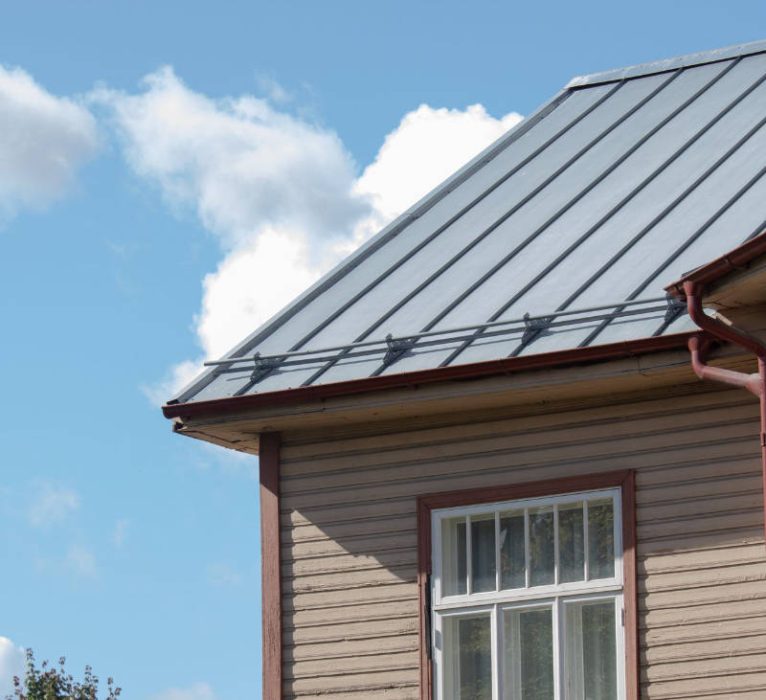
I watched a hailstorm roll through my neighborhood and leave two houses on the same block with completely different outcomes. Mine had a shingle roof that looked like someone attacked it with a hammer. My neighbor’s metal roof? Not a mark. Same storm, same street, wildly different Monday morning.
That morning cost me a deductible and three weeks of tarp anxiety. It also taught me something worth sharing: the roof material you choose decides whether hail is a nuisance or a catastrophe. Stone-coated steel, standing seam, and other metal systems absorb impact energy in ways asphalt simply can’t, and the gap shows up fast when golf-ball-sized ice is falling out of the sky. Metal doesn’t resist hail because it’s stronger, it resists hail because it flexes. Asphalt cracks under impact. Metal gives slightly and springs back.
What actually happens when hail hits an asphalt roof
Shingles are basically asphalt-soaked fiberglass mats layered with mineral granules. Those granules are the armor. When hail strikes, it knocks granules loose, and once they’re gone, the asphalt underneath is exposed to sun and rain. You won’t see the damage from the ground, but your insurance adjuster will see it from a ladder.
One hard hailstorm can take decades off a shingle roof’s life without a single visible hole. That’s the part that surprises people. There’s no water pouring through your ceiling, so you assume you’re fine. Then six months later you’ve got a soft spot over the spare bedroom.
Posts on this site may contain sponsored content, paid link placements, or affiliate links. I may earn a commission or fee if you click a link or purchase through these recommendations at no additional cost to you.
If you want the hard data behind why hail damage varies so much from storm to storm, the National Weather Service tracks hail size and reports by region, and the difference between pea-sized and golf-ball hail is not incremental. It’s a different category of event entirely.
How metal handles the same impact
Metal roofing has a long history of performing well in hail-prone regions, and the reason isn’t complicated. Steel and aluminum panels distribute impact force across a wider area instead of absorbing it in one spot. A dent might form on a soft metal panel, but a properly specified 24-gauge standing seam panel typically shrugs off what destroys a shingle roof.
Stone-coated steel is my personal pick for hail country. It looks like tile or shake, it takes impact extremely well, and it doesn’t have the oil-canning cosmetic issues you sometimes get with bare smooth metal.
Dents matter for a different reason than you’d expect: insurance. Some carriers will pay to replace a dented metal panel, and some won’t, because a cosmetic dent doesn’t compromise the roof’s function the way a granule-stripped shingle does. Read your policy before you assume.
What determines whether your metal roof survives
Three things do most of the work. Gauge, or thickness. Panel profile, meaning how the metal is shaped and whether standing seams give it structural rigidity. And fastening, meaning how the panels attach to your deck.
Thicker metal takes more impact before it deforms. Standing seams add stiffness because the fold itself becomes a structural rib. Proper fastening means the panel doesn’t lift or shift when wind and hail hit at the same time, which is when most real damage happens.
Every metal roof installation lives or dies on those three variables, plus the quality of the underlayment beneath. A great panel on bad underlayment is a mediocre roof. A modest panel on excellent underlayment is a great one.
Is metal roofing more expensive, and does it pay you back?
Yes, metal costs more up front, typically two to three times what asphalt costs for the same square footage. That math changes over time. A metal roof lasts decades longer, which is why people hunting for long-lasting metal roofing solutions tend to be people who’ve already replaced a shingle roof once and don’t want to do it again.
The other variable is insurance. Metal roofing can qualify homeowners for premium discounts in hail-prone states because insurers have watched the claims data for years. Call your agent before the roof goes on, not after. A discount you didn’t ask for doesn’t show up on your bill.
Wind and hail aren’t the only forces your roof fights. According to the U.S. Department of Housing and Urban Development, homes that manage heat and moisture poorly pay for it in energy costs and long-term structural wear, and a good roof assembly plays directly into that equation through ventilation and drainage.
A quick pre-signing check for any metal roof quote
Before you sign anything, use this as your filter. Ask each contractor to answer every line in writing.
What panel gauge are you specifying, and why that one for my house?
Standing seam, exposed fastener, or stone-coated steel, and what’s the tradeoff?
What underlayment goes beneath the panels?
How are panels fastened, and what’s the wind uplift rating?
Is there a manufacturer warranty on the panel and a separate workmanship warranty?
Who handles the flashing around chimneys, vents, and valleys?
Two answers raise red flags instantly. Any contractor who can’t name a specific gauge is guessing. Any contractor who won’t put the underlayment spec in the contract is hoping you won’t ask.
I’d also push back on the lowest bid, every single time. The savings on a cheap metal job usually come out of underlayment quality and flashing detail, which are invisible for the first five years and very visible in year twelve.
The part most people miss
Metal will absolutely survive a storm that destroys an asphalt roof. But that claim comes with conditions, and the conditions are all installation details. Same panel, two different crews, two different outcomes five years from now.
According to the U.S. Department of Energy, a properly installed and ventilated roof assembly can cut home cooling and heating loads meaningfully, which means the roof over your head is doing more than keeping rain out. It’s part of your energy picture whether you think about it or not. Metal performs well there too, especially with a reflective finish and correct attic ventilation beneath it.
If you’re tired of replacing shingles every dozen years after a storm, the math favors metal long before you factor in insurance. Just make sure the crew doing it treats the underlayment and flashing with as much care as the panels, because that’s where roofs actually fail.
Ask your next contractor one question before anything else: how many metal roof installations have you personally completed in this county? The answer tells you more than any brochure will. Mine did, and it’s the reason I stopped worrying about hail.
