
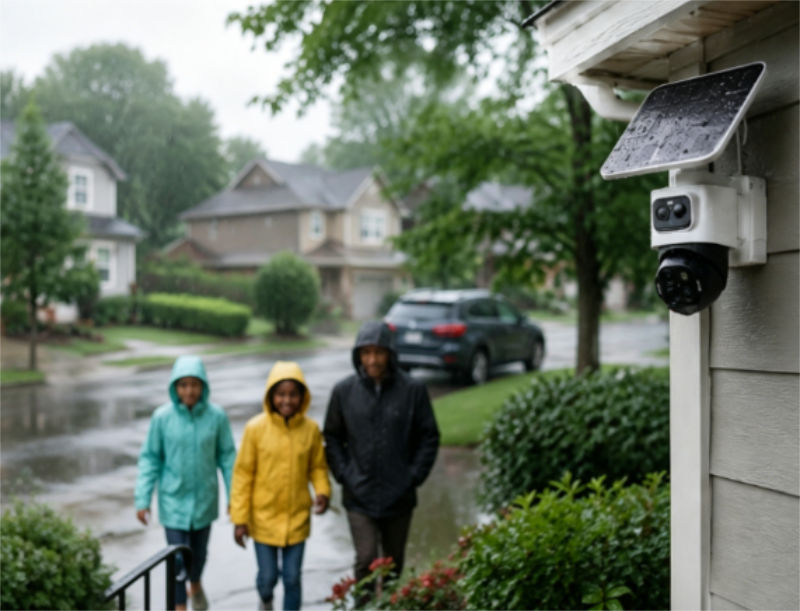
When you shop for outdoor security cameras for your home, you usually compare image quality, power, mounting options, and price. You may skim past the IP line and the operating temperature range on the spec sheet until something goes wrong outdoors: missed clips after a hot afternoon, moisture after unusual spray, or a seal that held at first but not years later. Those outcomes are not always about IP or temperature alone, yet those two specs are often what separates a camera that matches your climate and mounting spot from one that does not.
Below, the article walks through how IP digits split solids from liquids and how IP65 through IP67 differ on the liquid test, why operating temperature is not the same thing as the IP line, a simple way to check summer dropouts, housing and IK basics, a climate-by-mount matrix for rainy season, cold, and desert heat, and a separate look at lens fog, coatings, and defrost.
Table of Contents
- What each IP digit means and how IP65, IP66, and IP67 differ
- Operating temperature limits and what outdoor heat does to a camera
- How housing material behaves under thermal stress
- Matching the climate zone and installation spot to the right rating
- How fog and frost affect the lens, and what actually helps
- Conclusion
What each IP digit means and how IP65, IP66, and IP67 differ
Each digit after the letters IP answers a different question, so stop treating them as one combined score. IP stands for Ingress Protection. The first digit is for solid particles, mostly dust. The second is for liquids. In IP67, the 6 and the 7 are not added together, and they do not describe the same problem.
For outdoor security cameras that are weather-resistant enough for normal home use, the first digit is often already a 6. That is the top dust rating under IEC 60529, meaning dust-tight under the standard’s test conditions. In a backyard, that matters for pollen, fine dust, and windblown grit, but it is rarely the deciding difference between two current outdoor models.
The second digit is where people get tripped up. Level 5 is about water jets. Level 6 is about stronger jets. Level 7 is a short submersion test, up to one meter for 30 minutes. That last point is easy to misread. IP67 is not simply better rain protection; it is a different kind of water test.
There is a catch that tends to show up later. The IP test is not an aging test. A new camera can pass IP67, while the same housing, after years of UV exposure and daily heat swings, may no longer seal the same way. Rubber gaskets flatten. Plastic edges move a little. Cable openings become the weak point if the installer rushes the job. The rating is still useful, just not a lifetime promise.
Most field failures come from spray angle, pooling water, or pressure pushing into a seam, not from ordinary rain being too wet by itself. With the solid side usually at 6 as above, the practical gap between IP65, IP66, and IP67 is almost entirely the liquid side of the table.
| Rating | Water test | What it covers in practice | Typical home install |
| IP65 | 12.5 L/min jet | Rain, splash, garden hose | Under eave, sheltered wall |
| IP66 | 100 L/min jet | Pressure-wash proximity, heavy downpour | Exposed wall, driveway post |
| IP67 | 1 m submersion, 30 min | Flood risk, pooling water, short soak | Near pool, low mount, irrigation |
IP68 exists for deeper or longer submersion with manufacturer-defined conditions; few home installs need to shop there. A clean IP65 install under a soffit can still outlast a sloppy IP67 job with an unsealed cable hole. Water follows openings, not labels.
Operating temperature limits and what outdoor heat does to a camera
Water is only half the outdoor story. A camera can pass IP67 and still misbehave in heat because operating limits sit on a separate line from IP.
Many outdoor security cameras for home list about -4°F to 122°F (-20°C to 50°C). That margin looks comfortable until the housing sits in direct sun. In Phoenix, Las Vegas, inland California, or central Texas, a housing in strong sun can often run roughly 30°F to 40°F hotter than the surrounding air on a clear afternoon, which still pushes internal temperatures toward their limit.
The failure pattern is dull and easy to misread as network trouble: stable in the morning, gaps in the afternoon, recovery after dusk, mostly on hot summer days. Some units throttle, restart, or keep live view while dropping event clips. If the timing matches that pattern, log times for a week, add temporary shade or a visor, and see whether the problem mostly disappears before you swap access points. Heat and weak Wi-Fi can look identical in the app, so placement test matters.
Mounting still matters more than incremental IP shopping: south and west faces run hottest in the Northern Hemisphere, lighter housing colors pick up less heat than black or dark gray, and a tight soffit pocket with poor convection runs hotter than an open bracket mount.
None of that is encoded in the IP rating; it lives in the operating environment row. Cold mirrors the same idea: lithium batteries shed usable capacity quickly below about 32°F, so a 30% reading in January is not the same story as 30% in October.
How housing material behaves under thermal stress
Housing material rarely gets the same attention as resolution, but it affects what happens after the first year outside. Most consumer outdoor cameras use polycarbonate, often shortened to PC. It keeps weight down, molds cleanly around antennas and lenses, and handles normal home exposure well enough for most installations.
The weakness is not instant failure. PC can soften slightly at high surface temperatures, and years of hot-cold cycling can change how seams press against gaskets. On a shaded porch, that is usually not a big story. On a sun-baked stucco wall, it is worth caring about.
Aluminum behaves differently. It sheds heat faster and holds its shape more consistently across temperature swings, though it adds cost and weight. That is why metal housings show up more often in commercial or semi-commercial cameras than in small battery models for a front porch. For most homes, a PC is not a red flag. The risk rises when the camera is expected to sit in direct sunlight for years and still keep a tight seal.
Anti-vandal housing belongs in a different column. The rating to look for is IK, not IP. IK08 and IK10 are common in commercial installs and describe impact resistance, not water sealing. A camera can be hard to smash and still only average in rain protection. For a home, vandal-resistant construction mostly matters when the unit is reachable from the ground, mounted along a public walkway, or placed where someone could cover or twist it without much effort.
Matching the climate zone and installation spot to the right rating
Buying by rating alone is where mistakes creep in. Climate decides stress. The mounting location decides whether the camera meets that stress head-on or gets some protection from the house. Under eave means real roof cover; exposed install is a wall or bracket with no roof overhead; pole or post carries the same sky exposure but adds more vibration and cable gland strain.
| Climate band | Under eave | Exposed install | Pole or post |
| Rainy season (heavy seasonal rain, wind-driven spray) | IP65 is often enough if cable entries are sealed | IP66 is the safer default | IP66 at minimum, check gland strain and drip loops |
| Extreme cold (long stretches below 20°F, ice, freeze-thaw) | IP65 can still work, prioritize low-temp spec and battery charging behavior | IP66 plus verified low-temp operation, expect shorter battery life | Same as exposed, add anti-ice buildup on the mount and inspect seals after thaw cycles |
| Desert high heat (frequent 100°F+ days, intense sun, dust) | IP65 may be fine for water, still verify upper temperature limit and sun shielding | IP66 for dust and wind-blown mist from blowers, prioritize light housing color and midday shade | Same as exposed, add strain relief so heat cycles do not tug the cable out of the gland |
Coastal salt and pool-adjacent splash are not extra table rows, but they usually justify one higher liquid IP on exposed or pole mounts and make gland sealing mandatory everywhere. Workmanship beats the badge: an open cable entry wastes IP67, a careful IP65 eave install can outlast it, and years of sun on polycarbonate can loosen trim long before recordings start to fail.
Posts on this site may contain sponsored content, paid link placements, or affiliate links. I may earn a commission or fee if you click a link or purchase through these recommendations at no additional cost to you.
If you want a concrete example besides that IP65-versus-IP67 split, the eufyCam S4 4-Cam Kit is IP65 weatherproof and rated from -4°F to 131°F (-20°C to 55°C). The 131°F high side is a few degrees beyond the common 122°F (50°C) ceiling on many outdoor cameras, which gives a bit more headroom on paper when afternoon shell temperatures climb on sun-heavy walls, though mounting and shade still matter first.
How fog and frost affect the lens, and what actually helps
Lens fogging tends to show up during rapid temperature swings: a cold housing warming in early sun, or a warm unit cooling into evening fog. It is often blamed on waterproofing, but a good seal can still leave moisture on the outer lens if the air outside is saturated.
Anti-fog coatings are a partial answer. Hydrophobic coatings bead water off in light mist; hydrophilic films spread it into a thin sheet so the image stays usable, but both wear over time, and neither prevents internal fog when moisture is trapped inside the housing. Desiccant inside the housing slows internal fog during the early years, but does not help once the seal path is damaged.
Defrost in outdoor cameras usually means a heated glass element or heater ring near the lens, more common on wired commercial domes because continuous heat draws power. If repeated winter icing is likely at your location, check whether the spec sheet mentions a heater or defrost mode before buying. A camera listed as IP67 with no condensation control will still fog or ice under the right conditions.
Conclusion
An IP rating is only the lab dust-and-water column. It does not cover 10°F battery behavior, years of sun on plastic housings, or the cable path behind the mount, but you still treat it like a full weather warranty. Sheltered temperate eaves often land on IP65, rain-heavy or coastal exposed walls usually want IP66, and IP67 makes sense when pooling or soak risk is real. Temperature limits, sun direction, housing material, condensation behavior, and gland sealing deserve the same attention once you settle on that IP row.
For comparing current models and their environmental specs, the eufy outdoor security cameras collection is a useful place to check ratings before choosing a mounting spot. Pick the camera for the wall it will live on, not just the highest number printed beside IP.
